

















— why gobby is different
Start with what people
actually say.
Open questions + answers
Ask openly and hear answers you did not write first. People respond in their own words, making room for context, unexpected issues and ideas predefined options may miss.
Peer analysis
See what resonates across the group. Relevant answers can be surfaced as people respond, helping participants recognise and validate shared experiences.
Thematic analysis
Turn hundreds of answers into themes you can inspect, also known as coding. Code responses, review source evidence and compare groups, with optional AI assistance and human judgement in control.
— Surveys built for you
Better Engagement Fast…
Whether you’re working in business, healthcare, academia, local government, or making social impact, Gobby helps you cut through the noise and uncover what matters most.

Business & Not-for-Profit
Engage and converse with your employees on an ongoing basis that isn’t just box ticking and vote counting. Gain repeated insight, reach out for public engagement and develop inclusive co-production.

Researchers & Universities
If you are involved in any participatory research we offer total control over submission, privacy, data collection and delivery. Use our internal tools or export raw data. We specialise in qualitative and mixed methods for efficient data collection & analysis.

Healthcare, Social & Public Sector
Serving the whole community and ensuring that diversity, equity and inclusion are at the heart of true insight. We help you to emphasize all the stakeholder voices to enable better social value reporting.
— the problem with traditional surveys
They ask questions.
But they miss the point.
Traditional surveys are useful when you know what you need to measure. They are less useful when you need to discover what you have not thought to ask about yet.

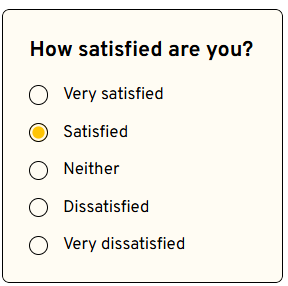
Closed questions limit truth.
Tick boxes and rating scales force people into answers that may not reflect how they really feel.

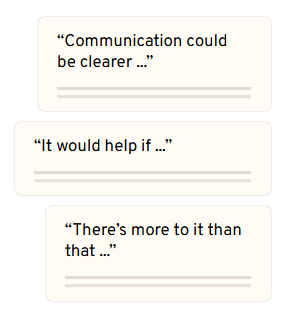
Open comments get ignored.
People leave thoughtful feedback, but it gets buried in spreadsheets where the insight is lost.

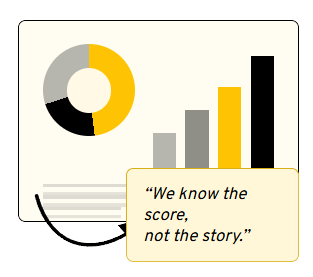
Data without context leads nowhere.
Numbers alone cannot tell you why something is happening or what to do about it.

One-way surveys don’t build trust.
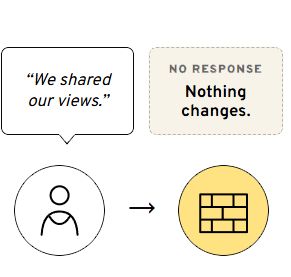
People share their views, but there is no visibility, no dialogue and no sign that anything changes.
Built for change makers.
Not box tickers.
More Answers.
Fewer Questions.
— useful answers
Before
you ask.
Clear answers about the approach,
without the software fog.
Gobby is a qualitative focussed survey software tool for collecting genuine voices. It has an innovative approach to collecting, grading and themeing open-text answers. Gobby aims to show shared experiences through peer analysis; and by organising qualitative feedback into clear, inspectable, themes.
A qualitative survey uses open, or free, text questions and answers that allow people to explain what they think, experience or prioritise in their own words. It is essential when context and non-typical answers matter but is invaluable with any survey that seeks to understand what its participants really think. We give you the ‘why’ and not just the ‘what’ and ‘when’ of a response.
Many survey tools focus on pre-defined answer choices and summary scores, they make you tick boxes and from that formulate an average answer, replacing thoughts with statistics. Gobby brings open answers, peer analysis and thematic analysis together while keeping source evidence available for review. We also allow you to collect and rate only the figures you want to see and that help you to further understand the impact of what is being said.
You ask a question without deciding every possible answer in advance. Participants write their own response, creating room for nuance, context and issues the question writer may not have anticipated. We provide tools to allow people to match, theme, responses, or not. That’s your choice if you want to let them.
We also supply tools to report and moderate responses giving you peace of mind that participants can be protected and surveys can contain relevant, acceptable responses. You can still focus on specific targets but it is done textually not just by statistical calculation.
Peer analysis helps to show what resonates across a group. Gobby can reveal relevant answers, we call them matched responses, from other participants, so people can recognise and validate experiences that reflect their own, or that they are in agreement with. From this you can see the weight a particular point of view has in your respondents.
Thematic analysis involves sorting and grouping responses, this is also called coding (and if you know what you want to do we also give you the tools to do pre-coding).
You group or relate words and phrases into themes, reviewing the evidence behind those relationships to understand patterns across the research. Gobby has a range of tools to help you to do this themeing, and we also offer research services that can do the work on your behalf, from a guiding hand to fully managed surveys.
Gobby uses (completely optional) AI assistance, we call this the Gobby Assist tool. This tool can help identify and organise your survey answers and help you with the difficult task of understanding the open text responses.
You can still review the original responses, refine the analysis and decide what the findings mean and we make sure to clearly identify what was made by a human and what was uncovered using automated tools so you have peace of mind and a way to correctly audit your surveys.
Gobby can support comparison of themes across demographic or participant groups, helping teams see where experiences align and where smaller patterns may differ from the overall picture.
No. AI is an optional support layer within our analysis, not a requirement and not a replacement for researchers, lived-experience review or human judgement. At Gobby we believe in human-led and human-governed research and analysis to ensure that people are kept at the centre of all that we do.
Yes, you absolutely can try it for free and we do not restrict any features. We supply up to 50 responses (that’s a person who fills out the survey) and no credit card is required.
Note: uncompleted surveys are part of your 50 free allowance as whatever they fill in is still recorded and can be analysed.

