

— positive change through engagement
We have a long relationship with organisations that engage.
Many organisations have the best intentions.
Charities, social enterprises, community organisations, and public sector teams engage to understand experiences, improve services, strengthen communities, and create positive change. But engagement activities can struggle to maintain participation. People stop responding, attending, or sharing. This is not because they have nothing to say, it is because they cannot see how their contribution influences decisions or led to change.
Meaningful engagement is about more than collecting feedback.
It is about creating opportunities to share experiences, identifying where they connect with others, and turning collective intelligence into action. Organisations that demonstrate that people’s contributions matter see trust grow. If they cannot participation declines.
As UK Health Security Agency (UKHSA) noted in 2025: “Engaging with affected communities is a fundamental component of Inclusion Health approaches.”
This extends beyond health, to improving services, shaping policy, or strengthening communities. Meaningful engagement begins with recognising that people close to an issue might hold answers to improving it.
— Common Engagement Pitfalls
Oganisations can fall into patterns which make participation difficult.
Focusing on Participation Rather Than Influence.
Many organisations measure success through participation numbers. How many surveys were completed? How many people attended? How many responses were collected? These metrics can be useful. But participation is only the beginning.
The more important question is whether participation influenced decisions, services, policies, or priorities. People are far more likely to engage again when they can see that their contribution mattered.
Collecting Scores Without Understanding Experiences.
Traditional surveys rely heavily on numerical ratings and predefined answers. Numbers can tell you that something is happening. They rarely explain why. A satisfaction score may indicate concern, confidence, or frustration, but it cannot explain the experiences behind that score or reveal what people believe should happen next.
Listening to people in their own words helps organisations understand not just what people think, but the experiences that shaped those views.
Hearing Individual Voices but Missing Collective Insight.
Qualitative feedback is rich and valuable, it can also be difficult to analyse. Organisations that find themselves with hundreds of comments but no practical way to identify common themes, shared priorities, or areas of broad agreement find that valuable insight remains hidden.
The challenge is not hearing individual voices; the challenge is understanding what those voices are saying collectively.
Trying to Fix Everything at Once!
Engagement often uncovers multiple challenges and opportunities and the temptation is to tackle everything.
In reality, trust tends to grow when organisations focus on achievable priorities and demonstrate visible progress. Small improvements that people can see are often more powerful than ambitious plans that never materialise.
— The Engagement solution
A Framework for Meaningful Engagement
Successful engagement does not require complicated methodologies.
It requires a clear process that people can understand and trust.

Listen
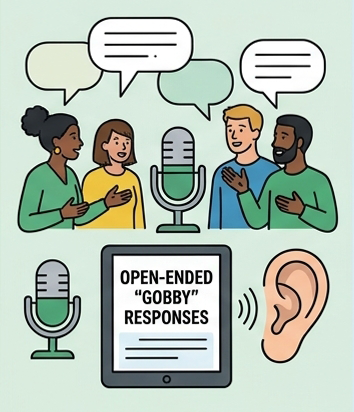
Create opportunities for people to contribute in their own words. Ask questions that encourage experiences, perspectives, and ideas rather than relying solely on predefined responses.
The goal is not to generate more data, the goal is to hear what matters.

Connect
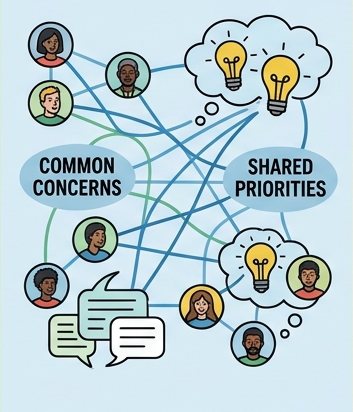
Look beyond individual responses and explore where experiences overlap. Identify recurring themes, common concerns, shared priorities, and areas of agreement. This is where collective intelligence begins to emerge.
People often discover that others share similar experiences, while organisations gain a richer understanding of what matters across a wider community.

Act
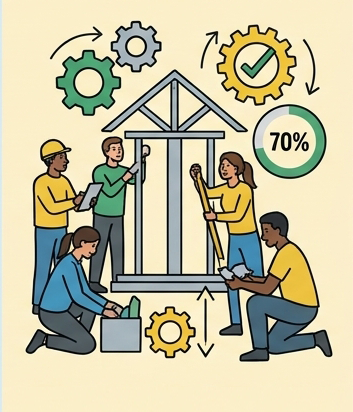
Prioritise one or two achievable actions and avoid creating lengthy action plans that struggle to move beyond good intentions.
Visible progress demonstrates that participation leads to meaningful outcomes.

Report
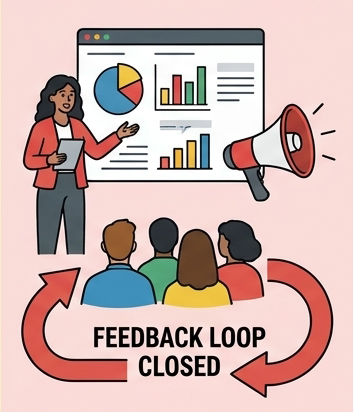
Show people what was heard, what was learned, and what happened next. Be transparent about decisions. Explain what can be changed, what cannot, and why.
Closing the feedback loop helps people understand that their participation created value.
Research exploring the involvement of people with lived experience in service design found that:
“Evidence shows that involving people with lived experience during the creation, implementation and delivery of social care service is associated with better tailored services and improved satisfaction from the people using the services.”
– University of Birmingham, 2024
The message is clear. Participation becomes more meaningful when it influences decisions and contributes to visible improvements.
— supporting engagement
Gobby is ideally placed to support you
Gobby was designed to help organisations move beyond just collecting responses and showing reports.
Baked into our DNA is the desire towards developing deeper understanding of people, communities, and stakeholders.

Gather Richer Insight
Not every important question can be answered with a score. Gobby’s qualitative led approach gives people space to share experiences, perspectives, and ideas in their own words.
This helps organisations capture context, nuance, and lived experience that traditional tick-box surveys often miss.

Reveal Collective Intelligence
Every response tells a story, but the greatest value often emerges when organisations can see where stories connect.
Gobby helps identify areas of agreement, shared experiences, recurring themes, and common priorities across participants allowing organisations to go beyond the individual opinions to discover collective intelligence which can support stronger decision-making and more meaningful action.
— useful answers
Before
you ask.
Clear answers about the approach,
without the software fog.
Gobby is a qualitative focussed survey software tool for collecting genuine voices. It has an innovative approach to collecting, grading and themeing open-text answers. Gobby aims to show shared experiences through peer analysis; and by organising qualitative feedback into clear, inspectable, themes.
A qualitative survey uses open, or free, text questions and answers that allow people to explain what they think, experience or prioritise in their own words. It is essential when context and non-typical answers matter but is invaluable with any survey that seeks to understand what its participants really think. We give you the ‘why’ and not just the ‘what’ and ‘when’ of a response.
Many survey tools focus on pre-defined answer choices and summary scores, they make you tick boxes and from that formulate an average answer, replacing thoughts with statistics. Gobby brings open answers, peer analysis and thematic analysis together while keeping source evidence available for review. We also allow you to collect and rate only the figures you want to see and that help you to further understand the impact of what is being said.
You ask a question without deciding every possible answer in advance. Participants write their own response, creating room for nuance, context and issues the question writer may not have anticipated. We provide tools to allow people to match, theme, responses, or not. That’s your choice if you want to let them.
We also supply tools to report and moderate responses giving you peace of mind that participants can be protected and surveys can contain relevant, acceptable responses. You can still focus on specific targets but it is done textually not just by statistical calculation.
Peer analysis helps to show what resonates across a group. Gobby can reveal relevant answers, we call them matched responses, from other participants, so people can recognise and validate experiences that reflect their own, or that they are in agreement with. From this you can see the weight a particular point of view has in your respondents.
Thematic analysis involves sorting and grouping responses, this is also called coding (and if you know what you want to do we also give you the tools to do pre-coding).
You group or relate words and phrases into themes, reviewing the evidence behind those relationships to understand patterns across the research. Gobby has a range of tools to help you to do this themeing, and we also offer research services that can do the work on your behalf, from a guiding hand to fully managed surveys.
Gobby uses (completely optional) AI assistance, we call this the Gobby Assist tool. This tool can help identify and organise your survey answers and help you with the difficult task of understanding the open text responses.
You can still review the original responses, refine the analysis and decide what the findings mean and we make sure to clearly identify what was made by a human and what was uncovered using automated tools so you have peace of mind and a way to correctly audit your surveys.
Gobby can support comparison of themes across demographic or participant groups, helping teams see where experiences align and where smaller patterns may differ from the overall picture.
No. AI is an optional support layer within our analysis, not a requirement and not a replacement for researchers, lived-experience review or human judgement. At Gobby we believe in human-led and human-governed research and analysis to ensure that people are kept at the centre of all that we do.
Yes, you absolutely can try it for free and we do not restrict any features. We supply up to 50 responses (that’s a person who fills out the survey) and no credit card is required.
Note: uncompleted surveys are part of your 50 free allowance as whatever they fill in is still recorded and can be analysed.

